Why Your "Repair" Deep Conditioner Isn't Actually Repairing Your Hair
You've done everything right. You deep condition every wash day. You leave it on for twenty minutes, sometimes longer. You buy the ones that say "repair" and "reconstruct" and "damage-reversing" on the label. And your hair feels better when you rinse — softer, smoother, easier to detangle.
But by wash day three, something's off. It feels heavier. Or drier underneath, somehow, even though the surface still looks okay. Or the product just stops doing what it did the first time you used it.
That's not your hair getting used to it. Something else is happening.
The Real Problem: Nothing Is Getting In
Most mainstream deep conditioners — and a lot of salon-quality ones too — rely on silicones to deliver that instant softness and slip. Dimethicone is the most common. It's cheap, consistent, and genuinely effective at what it does: coating.
Dimethicone works by sitting on the outside of the hair shaft. It fills in the gaps along the cuticle, smooths the surface, and reflects light. The result is slip, shine, and softness — immediately. It does this well. The problem is that it doesn't penetrate. It's designed to stay on top.
Over time, layer builds on layer. And as it accumulates, that coating starts acting as a barrier — blocking not just what's outside, but what needs to get in. Moisture. Protein treatments. The active ingredients in your next deep conditioning session. All of them have a harder time reaching the cortex of the hair when there's a silicone film sitting between them and the strand.
For hair that genuinely needs repair — porous, bleached, relaxed, color-treated, heat-damaged hair — this matters. You're spending time and money on treatments. A meaningful portion of their benefit can't get through.
You're not getting results because the product is working. You're getting results because it looks like it's working.
The Fix: Oils That Work From the Inside Out
There's a category of ingredients that does the opposite of coating: penetrating oils. These are oils with a molecular structure small and specific enough to actually enter the hair shaft — to work from inside the strand rather than sealing a barrier on top of it.
Unlike dimethicone, penetrating oils don't build up. They absorb. Each wash, your hair gets the benefit fresh. And because they're not sitting on the outside of the strand, they don't block what comes next — your other treatments can still reach the cortex and do their job.
For damaged or chemically treated hair, this distinction is everything. Silicone smooths the surface of a compromised strand. A penetrating oil works where the damage actually lives.
Why Broccoli Seed Oil in Particular
Not all penetrating oils are equal, and most of the well-known ones — coconut oil, argan oil — have trade-offs. Coconut oil penetrates well but can cause protein overload for some hair types. Argan oil is lighter but doesn't match the slip that silicone-heavy products deliver.
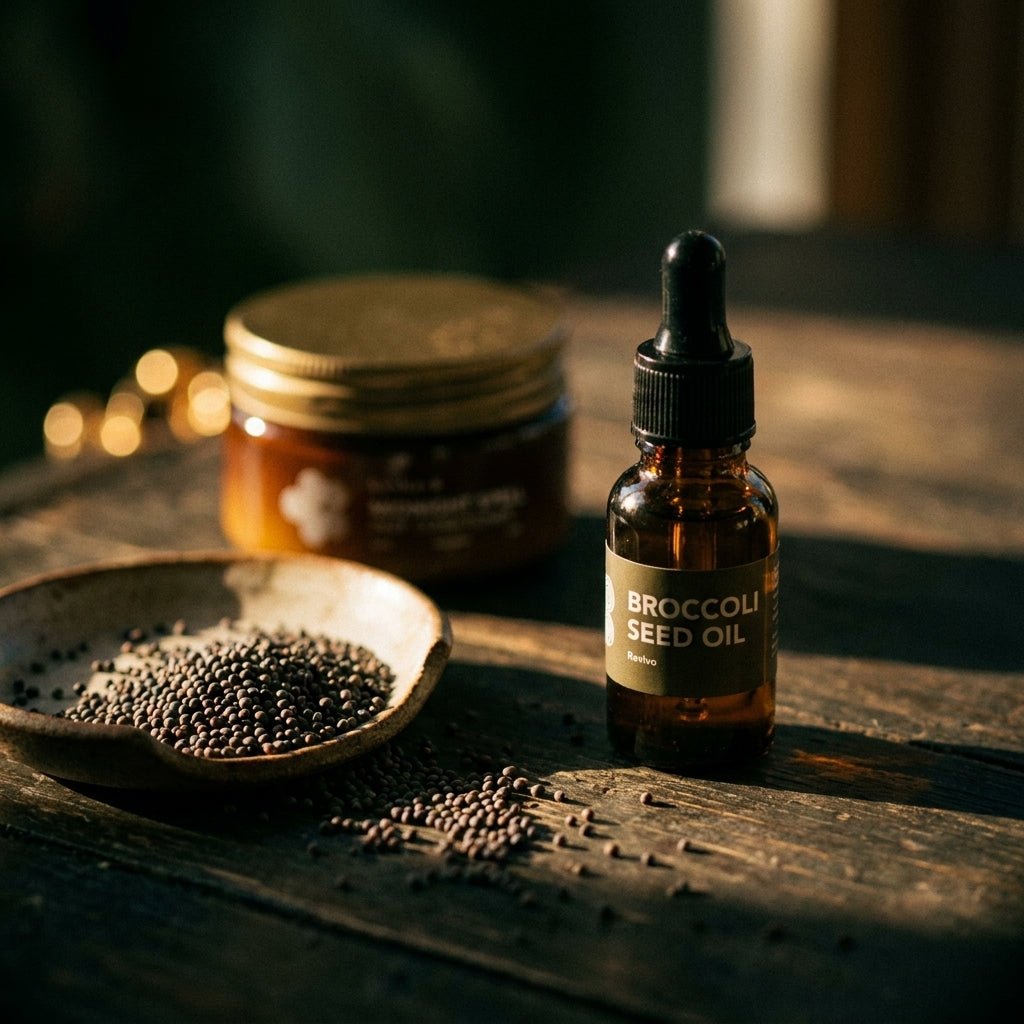
Broccoli seed oil sits in a different position. It's cold-pressed from the seeds of Brassica oleracea, and what makes it unusual is its fatty acid profile. It's exceptionally high in erucic acid — a long-chain fatty acid that makes up more than 50% of its composition. Erucic acid has a molecular structure that mimics the sensory properties of silicone on the hair. You get the slip. You get the smoothness. You get the shine. But the mechanism is completely different.
Instead of coating, it penetrates. It works from inside the strand outward, contributing to flexibility, reducing brittleness, and supporting moisture retention over time — not just creating the appearance of it.
And because it absorbs rather than accumulates, it doesn't interfere with anything else you're putting on your hair. No buildup. No barrier. No reset-and-repeat cycle.
For hair under the kind of stress common here in the Philippines — humidity, heat, hard water, frequent color treatment — this cumulative benefit is what actually changes hair over time, rather than just managing how it looks week to week.
What This Means for Your Hair Over Time
Here's the honest comparison: dimethicone gives you immediate, visible results that gradually diminish as buildup accumulates. Broccoli seed oil gives you results that build. The first use isn't going to feel like a before-and-after transformation. The tenth use will.
For chemically treated hair specifically — bleached, relaxed, permed, heavily colored — the cuticle is already compromised. The bonds inside the shaft have been altered. What that hair needs most are ingredients that can reach the cortex and work there. A silicone coating on top of a damaged strand is like repainting a wall with structural damage. It looks better. The problem underneath hasn't moved.
Penetrating oils work on the structural problem. Slowly, consistently, cumulatively. That's a different category of result.
It's why we chose broccoli seed oil for Midnight Spell — a deep conditioner built for hair that's been through something and needs ingredients that can actually reach it.
If your current treatment has dimethicone high on the ingredient list, it might be worth asking whether your hair is being repaired — or just temporarily covered.